In much of New England, it was a foggy Christmas in 2023. For the shovellers and working parents, it may come as a relief that Arlington has not yet seen its real first snow storm of the season. It is true that Central Massachusetts saw some flurries on November 1, and the South Shore received some ocean effect snow on December 6. But according to the walls of the Old Schwamb Mill, Arlington is overdue for its first snow.
The most common subject of graffiti on the walls of the Mill – chiefly the second floor – is the first snow of the season, written in pencil, black paint, or white gesso. With winter officially under way, and the new year approaching, we’ll share a few of these weather records.
First snow Nov. 13 – 1896

Some one enthusiastically recorded this storm several times in large letters high up in the second-floor western ell. It also appears immediately above, on the west wall of the third-floor frame finishing space. The Arlington Advocate reported (at right), “The first snow of the season for this section came on the evening and night of Nov. 13, and unlike most first snow storms amounted to something, the ground being thickly covered, and it remained more than forty hours; in fact considerably longer in shaded localities and in the woods.” As usual, Boston was wetter and warmer, the Boston Globe reporting, “The combination of sloppy streets, temperature, humidity and then descending rain and snow made the evening by far the most disagreeable out of doors so far this fall.”
Snowed Apr. 28th 16

OK, this is not a first snow; in fact it records the last snow of the 1915-1916 season.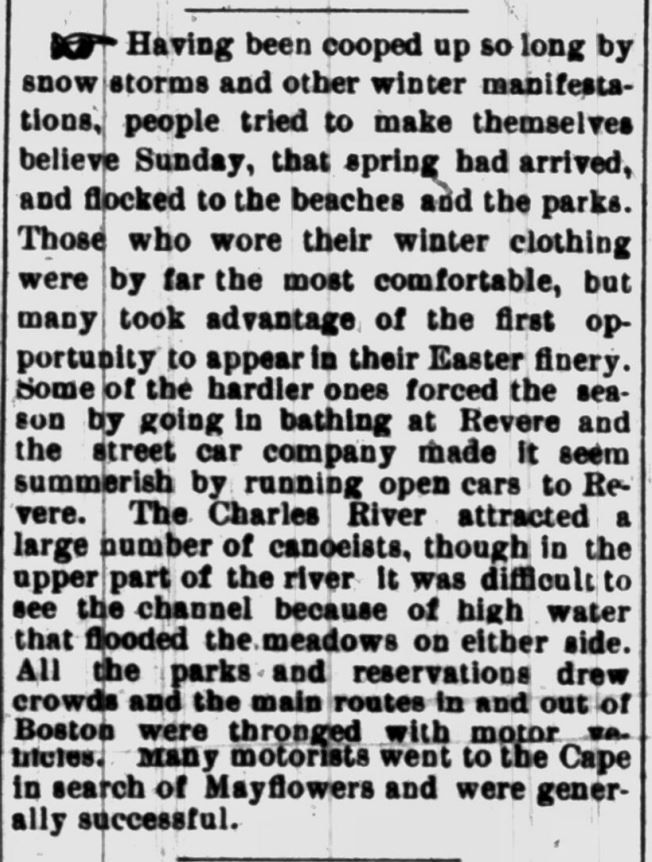
First snow Oct 2 1899

This light snow fell very early in the season. In its East Lexington Locals section, the Advocate asked, “Did you perceive the lovely snow flakes that fell so gently Monday evening?” This might be a touch of the newspaper’s smart sarcasm, as elsewhere it states, “Lexington had two snow squalls on Monday. To be sure they were brief, but as genuine flakes fell it was sufficient to make the opening fall season a record breaker. The nipping frosts on Sunday and Monday nights made sad havoc with the gardens, especially the squash vines and ornamental flower beds. Even flowers which were covered up, in anticipation of the frost, were frozen underneath their protection.”
 Much of what we now consider residential suburbs was farmland in 1899. Damage to fall autumn crops by this unexpected frost was a serious loss. The Globe (at right) reported the official temperature in Boston as 31 ½ degrees, but thermometers in the surrounding communities read lower, 25 in Newton, 20 in Burlington. Troops encamped in South Framingham awoke Monday morning to frost and ice. A runaway boy nearly froze to death in Cambridge.
Big Nnow Storm Feb 1 to 2 1898

We have wondered for years if “Nnow” was a joke of sorts – perhaps a predicted storm never materialized. 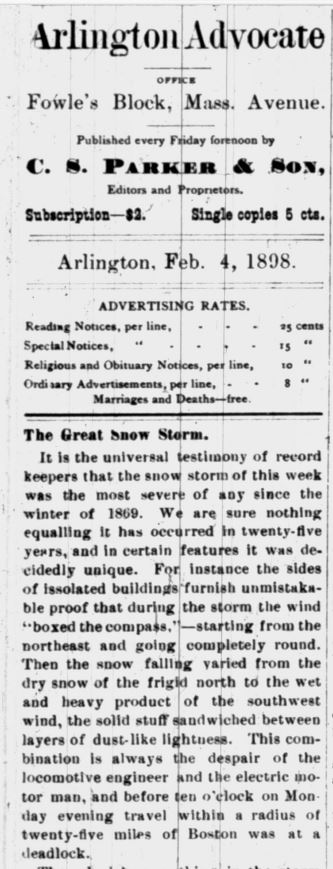 But, sure enough, the Advocate (at right) confirmed that the snow storm that began on the evening on Monday, January 31 was a big one. Trains, street cars, roads, telephone/telegraph lines were disabled across the region. Blowing snow and sleet caused ice to accumulate on wires, sometimes to a thickness of two inches, often bringing them down. Winds shifted during the storm, coating houses on multiple sides. Plowing was useless, said the Advocate; only shoveling could remove the dense snow from roads.
Trains on the Boston & Maine Railroad were stopped from reaching Arlington Monday night till Tuesday afternoon. “[L]arge numbers of out of town people, visiting places of amusement in Boston, spent Monday night in steam and electric cars or in waiting rooms at depots; and not until well into Tuesday afternoon were any considerable number of them able to reach home,” the Advocate reported. “Enterprising young men with sandwiches and hot coffee coined money…”
In our time, we can look back and recognize the inconvenience caused by the downed electrical and telephone lines. On the lighter side, we can share the Globe‘s amusement (below) with the numerous photographers who emerged on Boston Common after the storm to capture images of its snowy transformation.

Some actual photos of the blizzard on the Boston Common and elsewhere can be viewed in the online collections of the Boston Athenaeum.
First Snow, Nov. 25, 1898 J.F. Diehl

The author of this note, J.F. Diehl, worked at the Mill in the late 1890s. He may have been a moulder, an important job. His name or initials appear on the walls throughout the building. Clinton Schwamb included his name and address in the travel diary he kept during his trip to Colorado in 1901, suggesting they were friends.
This snow storm record appears on the north wall of the Mill’s second floor, an area later made inaccessible by the 14 feet deep moulding racks that were installed along this space. Graffiti of all kinds on this wall is often obscured or divided by twentieth century additions — the moulding racks, a separating wall in the glue room, and storage cupboards – that clearly post date the writing on these walls.
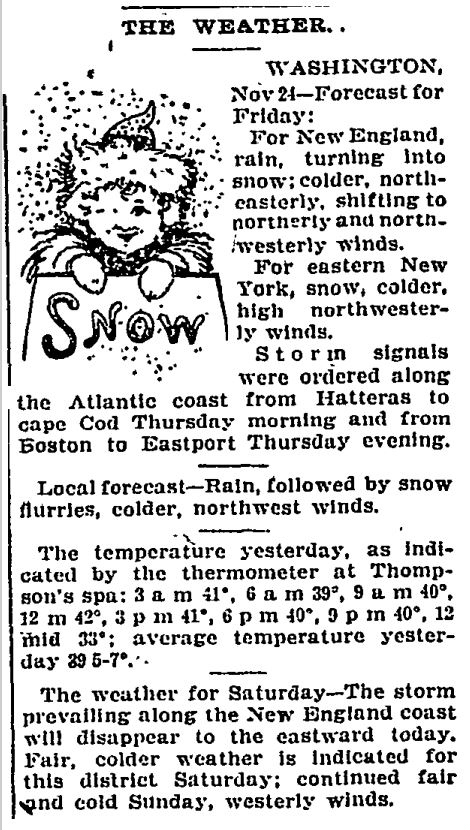 The Advocate commented generally on this Friday storm, noting the children’s half-holidays from school and the nuisance of boys throwing snowballs at passers-by in the center. The Arlington Enterprise, a competing weekly newspaper, noted wryly, “Citizens had their first chance to take a fall Friday morning on snow and ice.” The weather forecast in the Globe (at right) included the Friday storm but gave no hint of a worse one to follow on Sunday.
That storm on November 27, 1898, included heavy snow and high winds. The Advocate reported paralyzing snow falling from Sunday into Monday morning, closing church services, stopping electric trolleys, damaging Rawson’s green houses. Horse teams required two hours to get free of a drift at Masonic Hall in Arlington. Along the Massachusetts coast, ships in and out of port were devastated, with loss of vessels and many lives. The most famous loss was that of the Portland, a steam ship that set out from Boston on Sunday and sank in the storm off the coast of Gloucester. As many as 245 passengers and crew may have been lost, including two visitors to Arlington. The Enterprise reported, “Miss Helen Langthorne and her sister, music teachers of Portland Maine, were lost on the stammer [sic] Portland. They had spent a pleasant Thanksgiving with the family of Mr. Walter B. Henderson of Pleasant street place.”
The Globe documented much of the damage to coastal shipping (below).

The storm is still referred to as the Portland Gale.
The loss of the Portland was recorded (though mis-dated a day earlier) on a second floor wall in the Mill’s east ell.

Dermot Whittaker, Schwamb Mill Preservation Trust, Inc.
An Annual Appeal Reminder: All non-profits depend on the generosity of donors. The Old Schwamb Mill is no exception. Please consider making a donation to the Mill securely online here. Or send a check made out to Schwamb Mill Preservation Trust, Inc., to the Old Schwamb Mill, 17 Mill Lane, Arlington, MA 02476.
 Old Schwamb Mill
That was so interesting, Derm – I read every word. I’m still very engaged by the Mill, even tho I haven’t been there for some time. Keep up the good work!
Peggy Clarke
LikeLike