Visitors to the Old Schwamb Mill will occasionally bring an oval frame, often a family heirloom, asking if we can identify its age or place of manufacture. Some of the owners wonder if their frame might have been made at this very nineteenth-century frame factory.
It is usually impossible to answer this question for older frames as there were dozens of picture frame factories in Massachusetts alone (according to the Massachusetts Census of Industry conducted every ten years in the later 1800s). These factories used similar woods, styles, and joining techniques, and we do not know what techniques were used by the Schwambs in the 1800s.
Until 1940, when Elmer Schwamb sold oval frames nationally under the name Elwane Company, the Schwambs made frames and moulding exclusively for other stores to sell. They did not mark or label their frames. If someone brings a frame with a label identifying the shop it came from, we can check the twentieth century ledgers to see if that shop was a customer, and possibly even compare the size, wood type, and profile of the frame to those in the Schwamb order books.
A recent frame donated to the Mill presented none of these difficulties. The frame, in pieces, was found in a carriage house in Chester, N.H., about 13 miles east of Manchester. The house on the property dates to 1750; their family had owned it from 1942 to 2020. Most helpful was the label on the back reading
FROM WM. H. FISK’S FRAME MANUFACTORY [4 Met]hodist [church] MANCHESTER [N.H.]

William H. Fisk (1826-1875) was a successful bookseller, bookbinder, and dealer in stationery and paper-hangings from 1847 until his death in 1875. The directories for Manchester, New Hampshire, add “picture frame manufacturer” to his business listings in 1854. His shop was on Elm Street in the ground floor retail space of the large St. Paul’s Methodist Church, often described in business listings as the “Methodist Church block.”
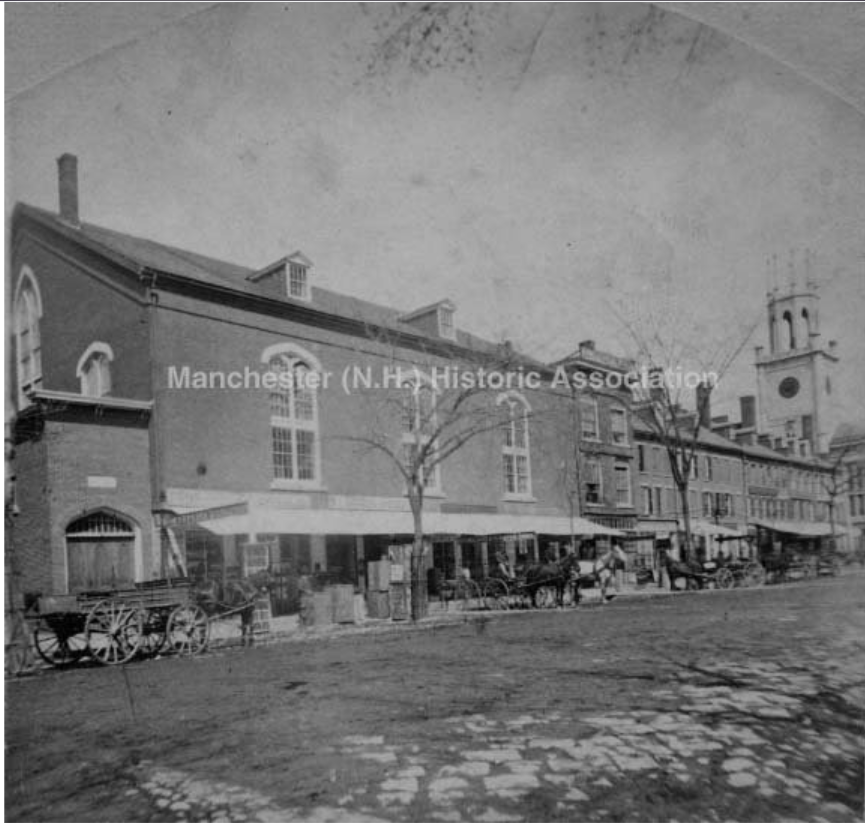
Fisk was also a printer and publisher. He opened a branch store in Concord, N.H., and at least once traveled abroad. According to the Concord Independent Statesman, when Fisk died of illness in 1875, he left “property estimated at 40,000 dollars.”
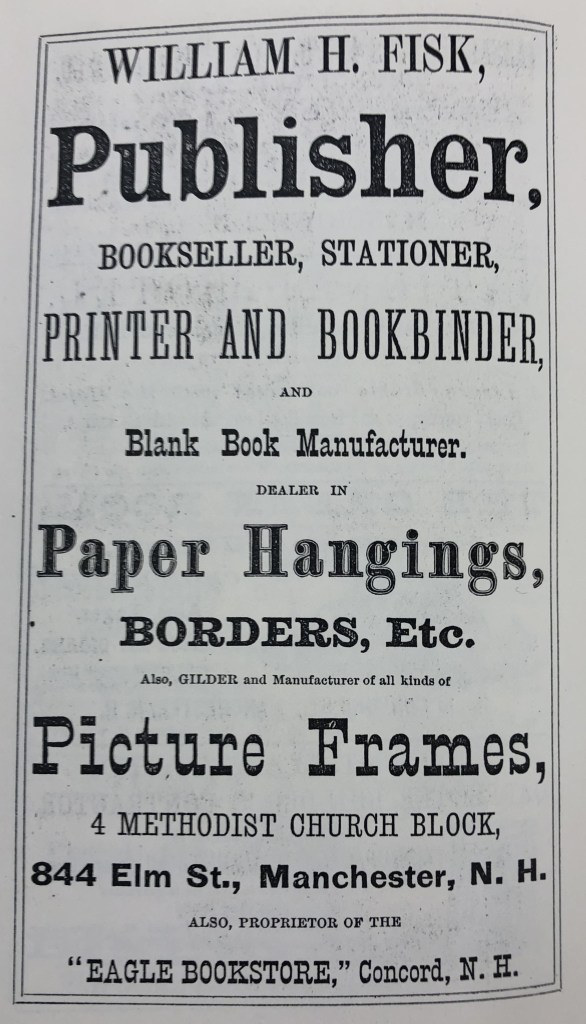
After his death, proprietors Charles W. Temple and Henry A. Farrington acquired his business, continuing all facets including frame manufacture. Temple, to whom Fisk bequeathed his gold watch and chain, had been associated with the business since about 1858. As late as 1888, Temple & Farrington operated the “Fisk Bookstore” under its own name alongside their own business, even after they moved operations into expanded quarters on Elm Street. They gave their date of establishment as 1847, the year Fisk began as a bookseller.
We don’t know how Fisk’s frame manufactory operated. It was approximately a quarter of a mile from the Merrimac River which powered large paper and textile mills in his day. His advertisements describe frame manufacture and gilding (including re-gilding) among his services. A few years after Fisk’s death, Temple and Farrington described their frame manufactory this way:
We have rooms especially fitted for the manufacture of Picture Frames of Every Description, from the Most Common Rustic to the Best Gold Frame. Having in our employ one of the best gold workmen in the country, enables us to give our customers as good work and lower prices than can be obtained on Boston or New York. Old frames and ornaments Re-gilded in the best manner. …Use 100,000 feet molding per year, for gold, gilt, walnut, plain, and ornamental frames for portraits, chromos, mirrors, engravings, wax, worsted, and feather wreaths, flowers, photographs, pictures, mottoes, etc., etc. Employ 7 hands in the manufacturing departments.
Pocket business directory and industrial and social statistics of the city of Manchester, N.H., 1879
William H. Fisk was of the same generation as Charles Schwamb, who was born in Germany in 1828. Both men started business in 1847, and both capitalized on the growing demand for frames, including oval frames, created by the new technologies of daguerreotype and photography. Charles Schwamb’s picture frame manufactory in Arlington, established in 1864, soon employed dozens more workmen than William Fisk’s operation, and no doubt produced more frames, but Fisk’s retail business was more diversified. By the 1870s, both frame manufactories were advertising frames for many purposes and in many styles, including gilded frames. In financial terms, the two men achieved comparable success.
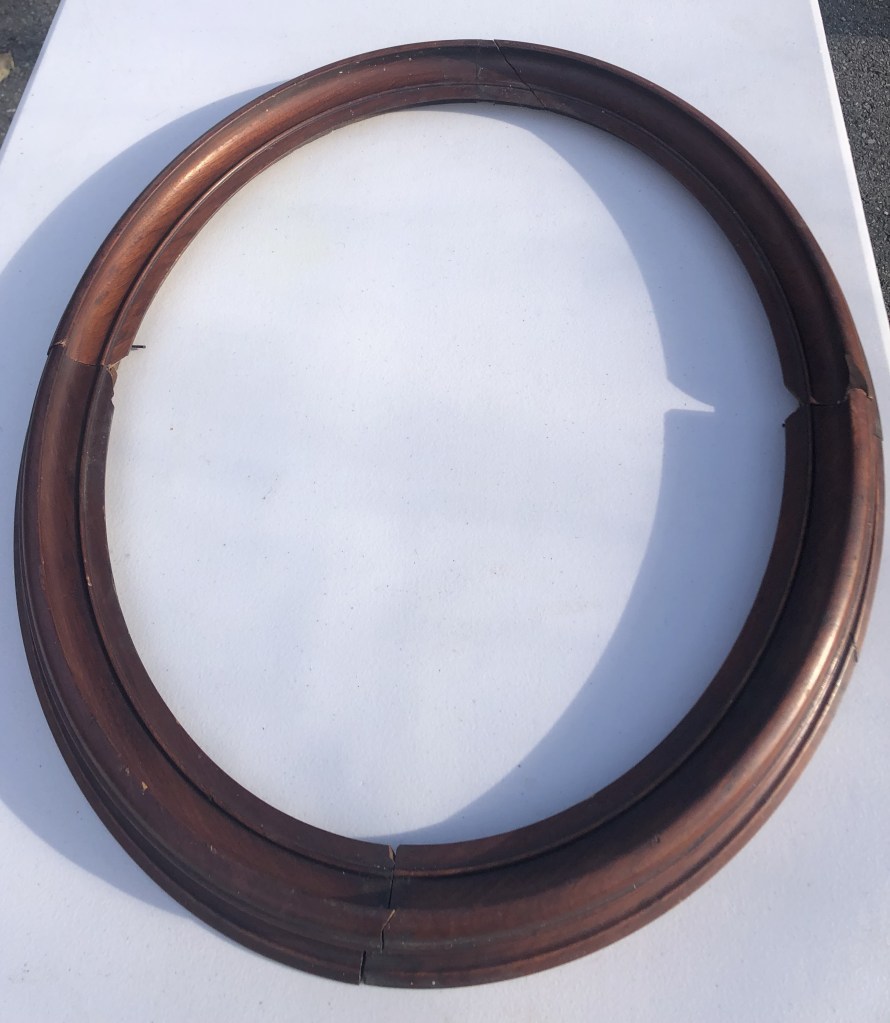
Fisk’s frame itself offers the clearest evidence of his company’s work. It is 23” by 19 5/8”, constructed from four quadrants of black walnut. The quadrants were glued with an overlapping joint (rather than a mortise and tenon or a finger joint). To make the frame thicker and wider, two layers of wood were glued together before being joined and turned. This practice was a common one; however, in the case of this frame, it appears that each layer was separately glued to each quadrant, before joining, intentionally creating the overlap that formed the glue joint.

The concave scoop with its pronounced overhang would usually require turning on an elliptical faceplate lathe similar to those used at the Old Schwamb Mill today. A frame like this would have been held tight to the vertical faceplate with four roughly equidistant screws passing through the faceplate and into the back of the frame. Seven screw holes appear on the back of this frame, though some appear to have been for hangers, and one quadrant shows no screw holes at all.

Our goal for this frame is to restore the glue joints, and either keep it for historical context or offer it to a collection of products manufactured in Manchester, N.H. Studying the frame and its manufacturer has shed light on a widespread New England industry and on a frame maker who operated at the same time as the early Charles Schwamb Company.
We would like to give special thanks to the Manchester Historical Association, 129 Amherst St., Manchester, NH 03101, whose volunteers and resources were of great help in researching William H. Fisk and his business. The Association operates an archive and research facility as well as the Millyard Museum, 200 Bedford St., Manchester, NH 03101.
Dermot Whittaker, Schwamb Mill Preservation Trust, Inc.
An Annual Appeal Reminder: All non-profits depend on the generosity of donors. The Old Schwamb Mill is no exception. Please consider making a donation to the Mill securely online here. Or send a check made out to Schwamb Mill Preservation Trust, Inc., to the Old Schwamb Mill, 17 Mill Lane, Arlington, MA 02476.
 Old Schwamb Mill
What fun! Thank you–so similar to the Schwamb story. Interesting contrast in joint methods.
LikeLike