Readers of “Schwamb Shares” know that the Mill’s accident reports – 78 copies of reports to the Mill’s insurer between 1915 and 1930 – hold a wealth of information about the Mill, its operations, its workers, and the injuries that occurred at work. The majority of forms name the physician who examined the employee, sometimes treating a cut, splinter or burn, or rinsing debris from an eye.

Of the 78 reports, 40 name a doctor who saw the patient. Another 20 state that the patient was seen at the clinic operated by the Federal Mutual Liability Insurance Company of Boston, the Mill’s insurer. It appears that in most cases, the injured worker was seen at the doctor’s office (nearly always an office in the doctor’s home) or the clinic, rather than at the Mill itself.

Of the four local physicians most commonly seen, two were relatively close to the Mill in Arlington Heights, one was further down Massachusetts Avenue near Jason Russell House, and one was east of Arlington Center. There is no record that the workers were referred to a particular doctor. Rather, it seems likely that workers choose the physician they were already familiar with. Workers injured more than once over the period of the reports usually saw the same doctor, often located near to where they lived.
Who were these local physicians who saw workers from the Mill? Here are the four who are named in the reports most frequently.
Robert H. Meikle
Office/home: 100 Park Avenue, Arlington Heights (just up the hill from Mass. Ave., roughly opposite Paul Revere Road)
Clinton Schwamb Co. injuries seen: 16 between 1915 and 1930
Reasons for visits: Scalds (from coal boiler), debris in eyes, bruised fingers, cut fingers and other flesh wounds, splinters, hurt back, head bump, wound infections.
Robert H. Meikle started his practice in Arlington in November 1900, opening an office at the corner of Massachusetts and Park Avenues, according to the Arlington Advocate. Some months later, the Advocate, in its breezy way, encouraged readers, “When you want Dr. Meikle, call him by ‘phone. His number is 331-2.”
By the 1920s, his home and office were further up the hill at 100 Park Avenue. Like the other physicians in Arlington, he was often named in the papers when a sick or injured person made the news: someone hurt in an automobile accident; a high school hockey team member rendered unconscious after a collision with another player during a practice match on Spy Pond; two young girls requiring stitches and treatment of bruises after sledding into Massachusetts Avenue and under a moving milk wagon.
The Advocate reported on October 5, 1907, that Dr. Meikle was lucky himself to have escaped death in a riding accident. “The doctor was driving down Lowell Street, when his horse became unmanageable in front of the Whipple Farm. … The doctor must have been dragged for some distance, as his clothing was torn and his head and face badly bruised.” Returned to his home by a fellow physician, he remained unconscious for days but eventually made a full recovery.
He and his wife vacationed at their summer home in Silver Lake, NH. For a time, he served as the physician for the Arlington schools. He was also a member of the Physicians Board of Symmes Arlington Hospital Corporation.
Roy Demas Young
Home/office/hospital: 788 Massachusetts Avenue (just west of Jason Street. His “hospital” had an office, an area for surgery, and beds for patient recovery)
Clinton Schwamb Co. injuries seen: 14 between 1919 and 1929
Reasons for visits: contusions to hands and other parts, torn nail, cut fingers and other flesh wounds, splinters, muscle strains, bone fractures.

The Arlington Directory first lists Dr. Roy D. Young in 1900, at 42 Pleasant Street. The Arlington Enterprise, on August 4, 1900, published an account of his private hospital located at that address, started with his office and study which “at a moment’s notice, can be converted into an operating room, with all the latest surgical instruments.” Among the devices described was an electrical device like “an ‘Ex-Ray’ in locating particles of steel, glass, etc., in the flesh” (possibly this refers to a fluoroscope, though this is very early for a doctor’s office to have a such a device). No doubt the device proved useful in years ahead as car accidents in town increased. Upstairs was the hospital with beds and nurse’s station.
Dr. Young moved his home and hospital to 788 Massachusetts Avenue by 1909. Here he treated the same sorts of patients as Dr. Meikle encountered: children in bicycle accidents, recipients of dog bites, illnesses. His facility proved adequate for intestinal surgery on a four-day old infant, accomplished with the aid of a colleague, as reported by the Advocate on September 21, 1923.
Dr. Young seems to have been adventurous. The Advocate reports that he completed a 1000-mile automobile trip in 1906. In July 1905, the Advocate described how Dr. Young and a friend left Boston for Portsmouth in a “22-foot gasoline launch,” encountered a storm and were unable to make headway. Young was able to beach the boat on Plum Island, where it was pummeled by the surf. The two shaken friends returned to Boston by rail.
Like his colleagues, Dr. Young also served as medical examiner for the Arlington schools. In the Depression years, the Advocate reported that he was named by the Board of Selectmen as “the physician to give medical treatment to CWA [Civil Works Administration] workers who may be injured while on duty.” He and his wife raised two boys, one of whom became a doctor in New York state. Dr. Young and family would depart for vacations to places such as Catskill Bay and Long Island.
Ezekial Pratt
Home/office: 385 Massachusetts Avenue (roughly opposite the GAR Hall, now home to the American Legion)
Clinton Schwamb Co. injuries seen: 6 between 1925 and 1929
Reasons for visits: Contusions (hand and elsewhere), splinters, infection, flesh wounds.
Dr. Pratt was active in Arlington in the 1920s and early 1930s. He too was a medical examiner for the Arlington schools at one point, as well as being named as physician to the Arlington Board of Health. The Advocate of May 17, 1929, reports that he and Dr. Charles F. Atwood, aided by three nurses, administered 500 doses of diptheria “toxin anti-toxin” at Town Hall, to children six months to ten years old. This was one of three such sessions that year, part of a seven-year project to vaccinate against what was then a common, often deadly, childhood illness.
Margaret M. Sanford
Home/office: 1300 Mass Avenue, Arlington Heights (on the corner of Davis Road and Park Avenue, where Cambridge Savings Bank now stands)
Clinton Schwamb Co. injuries seen: 5 between 1921 and 1927
Reasons for visits: Cuts to fingers, strained back.
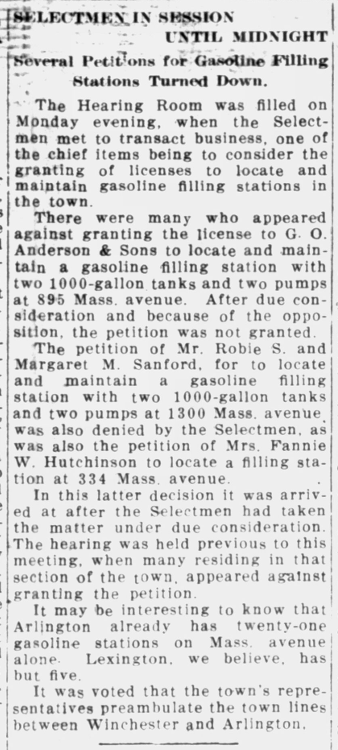
Dr. Sanford moved with her husband and two daughters from Boston to Arlington in 1898 or 1899. Her husband was Robie S. Sanford, an engineer. Dr. Sanford was listed among the 15 physicians in the Arlington Directory in 1900 and maintained her practice in town until moving to Allston around 1928. The Arlington Enterprise reassured readers on October 6, 1900, “A pleasant call made the other afternoon on Dr. Margaret Sanford confirmed us in what we have always believed, that woman is quite as competent to enter the professions as i[s] man. Dr. Sanford is a graduate of the schools and is an exceedingly pleasant woman to meet.”
While the few injuries she treated for Clinton Schwamb Company employees were minor, the newspapers report her treatment of car accident contusions and accidental burns that sadly proved fatal. Her home served patients recovering after surgery at Symmes Hospital and was a rest home for two elderly Arlington women no longer able to maintain their own house. Her own daughter’s surgery for appendicitis happened in her home as well, although we do not know the surgeon.
Dr. Sanford was active in many of the women’s clubs of Arlington and Lexington, hosting literary discussions, whist parties, and lectures. The Advocate reports her delivering lectures on physiology and yearly scientific news, as well as analyses of poetry and the short essay. In addition to this active social life, she often traveled, alone or with a companion, to places like Nova Scotia, California, Florida, Scotland, England, Belgium, France, and Italy – all reported faithfully by the Advocate. Her husband was equally independent in his travels. They maintained a summer cottage named “Riverdale” in Billerica.
It should be noted here that Dr. Sanford was not the first woman physician in Arlington. Julia Tolman practiced medicine in Arlington from the late 1880s until the 1920s. The Advocate on June 11, 1926, reported that she graduated from Vassar in 1884 and completed her medical degree at the University of Michigan. After a one-year internship in Boston, she moved to Arlington and established her practice. The Advocate also notes that Dr. Tolman did post graduate work at London, Paris, and Johns Hopkins.
We can safely assume that these physicians and others saw many more worker injuries than the 78 we have documented at the Mill. Indeed, the neighboring Theodore Schwamb Company, whose workforce was nearly 100, had of injuries similar to those at the smaller Clinton W. Schwamb Co. Arlington had other manufactories and farms where accidents could happen. In these years, the custom of seeing a family doctor in their own home office may have been a comfort — one grown strange to us a century later — to workers hurt in the course of their daily business.
For more on what the Mill’s accident reports reveal about the employees and business, see “What We Can Learn from the Mill’s Accident Reports.”
Dermot Whittaker, Schwamb Mill Preservation Trust, Inc.
An Annual Appeal Reminder: All non-profits depend on the generosity of donors. The Old Schwamb Mill is no exception. Please consider making a donation to the Mill securely online here. Or send a check made out to Schwamb Mill Preservation Trust, Inc., to the Old Schwamb Mill, 17 Mill Lane, Arlington, MA 02476.
 Old Schwamb Mill
Absolutely fascinating! Thank you.
LikeLike