TEXT VERSION:
THEODORE SCHWAMB & THE ERA OF THE GERMAN MILLS IN ARLINGTON
By Grace Dingee, Mill Historian and Board Member
In 1838, Jacob Schwamb emigrated to Boston from Untenheim, Rhein Hessen, Germany. Jacob was the first of the Schwamb brothers to emigrate to the United States. By 1857, six of the seven Schwamb brothers had emigrated from Rhineland Pfalz to the United States.
In their heyday, nine separate mills, each with one or two backup mill ponds, dotted the Mill Brook Valley along Massachusetts Avenue from East Lexington as far as Mystic Street in Arlington. The water of the Mill Brook was used by each mill wheel in turn, and the water was then passed on to the next. After 1872 the mills were forced to gradually convert to steam when the Arlington Heights residential plan was laid out and the town dug a reservoir on Lowell Street, in anticipation of the professional class expected to populate the Heights. The influx was not realized because a prolonged recession cut demand and the Arlington Land Company went bankrupt within two years. Complaints were also lodged that the water was not clean. In 1898, Arlington applied to join the Metropolitan water system and in 1899, its petition was granted. Thus, the Heights were able to escape the fate of having the waters of the Great Meadows flow into their sinks.
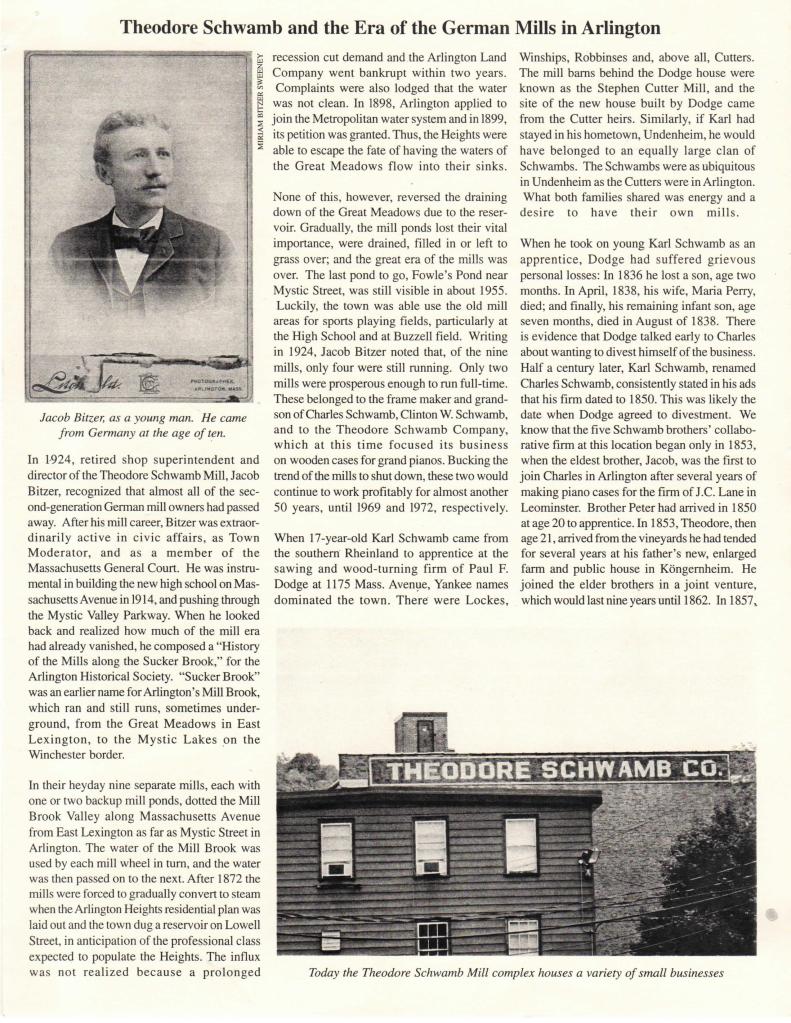
None of this, however, reversed the draining down of the Great Meadows due to the reservoir. Gradually, the mill ponds lost their vital importance, were drained, filled in or left to grass over; and the great era of the mills was over. The last pond to go, Fowle’s Pond near Mystic Street, was still visible in about 1955. Luckily, the town was able use the old mill areas for sports playing fields, particularly at the High School and at Buzzell field. Writing in 1924, Jacob Bitzer noted that, of the nine mills, only four were still running. Only two mills were prosperous enough to run full-time. These belonged to the frame maker and grandson of Charles Schwamb, Clinton W. Schwamb, and to the Theodore Schwamb Company, which at this time focused its business on wooden cases for grand pianos. Bucking the trend of the mills to shut down, these two would continue to work profitably for almost another 50 years, until 1969 and 1972, respectively.
When 17-year-old Karl Schwamb came from the southern Rheinland to apprentice at the sawing and wood-turning firm of Paul F. Dodge at 1175 Mass. Avenue, Yankee names dominated the town. There were Lockes, Winships, Robbinses and, above all, Cutters. The mill barns behind the Dodge house were known as the Stephen Cutter Mill, and the site of the new house built by Dodge came from the Cutter heirs. Similarly, if Karl had stayed in his hometown, Undenheim, he would have belonged to an equally large clan of Schwambs. The Schwambs were as ubiquitous in Undenheim as the Cutters were in Arlington. What both families shared was energy and a desire to have their own mills.
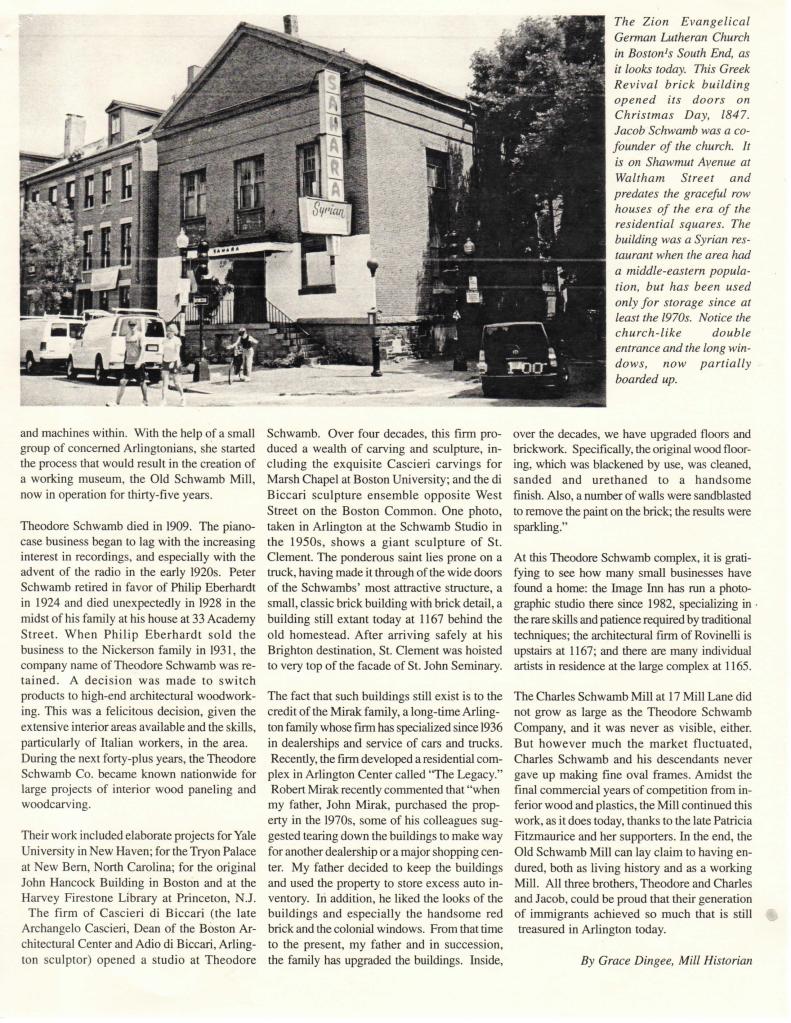
When he took on young Karl Schwamb as an apprentice, Dodge had suffered grievous personal losses: In 1836 he lost a son, age two months. In April, 1838, his wife, Maria Perry, died; and finally, his remaining infant son, age seven months, died in August of 1838. There is evidence that Dodge talked early to Charles about wanting to divest himself of the business. Half a century later, Karl Schwamb, renamed Charles Schwamb, consistently stated in his ads that his firm dated to 1850. This was likely the date when Dodge agreed to divestment. We know that the five Schwamb brothers’ collaborative firm at this location began only in 1853, when the eldest brother, Jacob, was the first to join Charles in Arlington after several years of making piano cases for the firm of J.C. Lane in Leominster. Brother Peter had arrived in 1850 at age 20 to apprentice. In 1853, Theodore, then age 21, arrived from the vineyards he had tended for several years at his father’s new, enlarged farm and public house in Kongemheim. He joined the elder brothers in a joint venture, which would last nine years until 1862. In 1857 the youngest and last brother, Frederick, arrived in New York City from Le Havre on the ship, Princeton, accompanied by his fiancée, Thekla Breivogel. Five days later Thekla and Frederick were married in the Zion Evangelical Lutheran Church of Boston’s South End, an early Greek revival brick building with classic pediment, which Jacob co-founded and helped to dedicate on Christmas Day, 1847.
As the first German to arrive in 1838, Jacob maintained his connection with the Zion Lutheran Church he helped to found, often “supplying the pulpit” himself in the absence of the minister. By 1853, however, he had begun to think better of settling on the scantily filled lands and commercial wharves of narrow Boston Neck. He had already buried two wives due to illness. He had worked in several piano factories in Boston and after 1842 had lived during an unhappy time of recession when his nearest brother, Ludwig, arrived to apprentice in woodworking, was forced to work in a lead-paint factory and fell ill with typhoid fever as well as lead poisoning. After a return to Germany, Ludwig reappeared in Boston in 1849, but passed through quickly, as if shaking the dust of Boston from his feet. He headed west to do what he had always wanted to do, to farm — first in Indiana and later in Missouri.
Perhaps also, Jacob found Leominster too undeveloped for a boy from the Rheinland. His foray there could have influenced his decision to join his brothers at 1171 Massachusetts Avenue in West Cambridge, a name Arlington retained until 1867. This was a proper town, yet with large tracts of undivided land, particularly in the Heights. The terrain was rougher for farming here than on the fertile eastern plain. But it was attractive for residences and businesses. In the coming decades, the Schwambs bought several of these areas from their Yankee owners. Jacob remarried again after two years, in 1855, to Katherine Guething. The couple added five more children to Jacob’s previous five; and the good Katherine had the grace to outlive Jacob by six years and, with two of her sons, to continue until her death in 1887 the piano-case and straight-molding business Jacob had established at 1033 Mass. Avenue. The story of Jacob’s mill didn’t end there either: Jacob’s youngest sons, William and Edward, carried on a furniture repairing and refinishing business together at 1033 Massachusetts Avenue until 1903, the year of William’s death. As late as 1926, The Arlington Advocate reported that Edward Schwamb was still running the furniture refinishing business in the same place. And a jolly side of Edward came out in his obituary in 1946 when he died at 84. He was characterized as a notable musician who led the music program for the town’s Centennial Celebration in 1907 and was the leader of the Arlington Zouaves Band. The Zouave soldiers were originally Civil War regiments with colorful costumes meant to resemble Berber tribesmen. Naturally, the story of Jacob’s offspring doesn’t end with the childless Edward. It is included to show the endurance, even of the least known of the Schwamb Mills, and the love of making music that ran through the German population in general, and the Schwambs in particular.
The business that the brothers started in 1853 was called, “Charles Schwamb and Brothers.” This underlined the role of Charles as organizer. Jacob pioneered by scouting territory and pinpointing piano production as a skill with a future: Now Charles saw strength in numbers for the immigrant brothers and launched the enterprise. The location at 1171 Mass. Avenue had an attractive house, two hams and a mill wheel. During the firm’s nine years of operation, the younger brothers apprenticed, became journeymen and joined the partnership. After the partnership was dissolved in 1862, the brothers started three separate businesses. Jacob, ever the restless family member, located himself in West Medford to make organ-cases for home use, a product of Mason and Hamlin Company. At the end of his career, Jacob returned to Arlington at 1033 Mass. Avenue where he ran his own mill until his death in 1881.
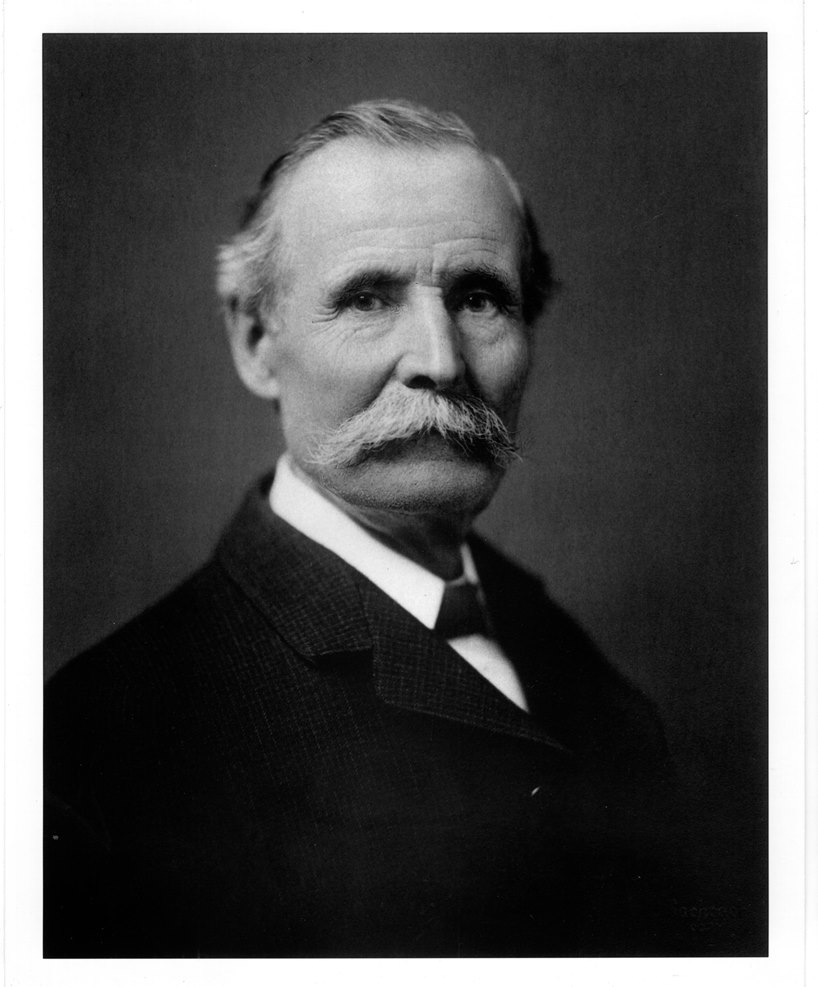
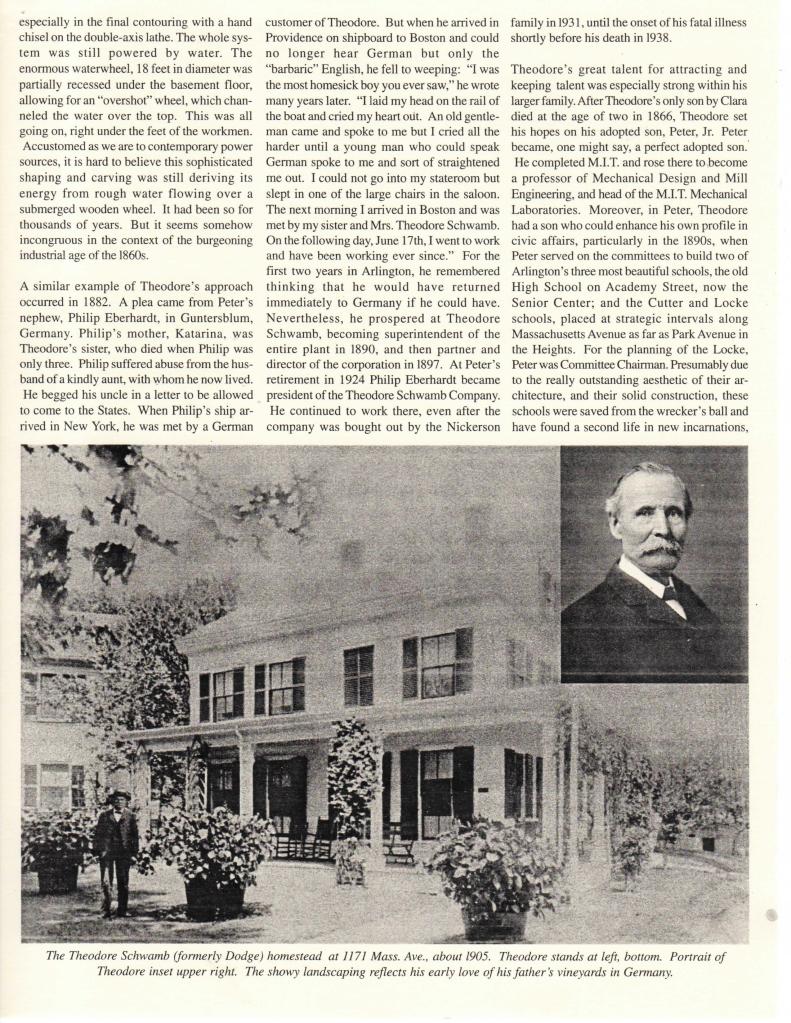
Theodore set his course to acquire 1171 Mass Avenue. It is not clear why he first located for a few years at 1093 Mass. Avenue near Hobbs Mill. He was determined to continue in the piano-case business and his eye was on the original location. By 1871 he was back at the Dodge homestead and had also acquired the Stephen Cutter Mill behind the house. Here, the largest of the three German mills in Arlington grew, the firm of Theodore Schwamb Company destined to last one hundred ten years and to remain important as the first and central location. The brothers all worked and lived close to one another for the rest of their lives, lending a hand in crises, and investing heavily in locations near one another in the Heights section of Arlington.
Sometime around 1850, Charles met Jane Sophia Hinton in the Choir of the First Parish Congregational Church (now Unitarian Universalist) in Arlington Center. Jane had been born in Birmingham, England. In 1852, Charles married his Jane and became the only brother to marry a girl with a non-German name. In this large, close-knit German family, one hopes that Jane managed to understand some German. Although Charles continued to walk often to Boston to attend services in German at Zion Lutheran Church in the South End, he was eager to become American as soon as possible; and an English-speaking wife fitted this plan.
A tragic event occurred in the brothers’ collaboration in 1858, when a younger brother, Peter, died on March 24. We do not know the cause, but he had married Clara Buecher, an immigrant from Graach, Rheinpreussen, only one year earlier and his first child, Peter, Jr., was only one-and-one-half months old at the time of his father’s death, suggesting a sudden and unexpected event.
Two years later, in 1860, Theodore married Peter’s widow and adopted Peter, Jr., showing a trait he would carry through his life—the instinct of a good administrator to bring people together for the greater good of the whole. Charles, who was imaginative as an innovator, did not have the same ability to integrate his personnel. In 1864, for instance, Charles and Frederick opened a niche business on Mill Lane just a short distance upstream from the Dodge location. The Woodbridge Spice Mill had come up for sale after a fire. Here Charles and Frederick installed their lathes and introduced a new technology directed at the thriving market clamoring for oval frames: The business was successful, yet Frederick remained only three years, leaving with his wife Thekla Breivogel for New York State, and ultimately for Blue Island, Illinois, a suburb of Chicago. It was as if Charles instilled his spirit of adventure in others, but not in a manner that was to his own advantage.
The new wooden oval lathes offered technology capable of turning out perfect ovals of all sizes in large numbers, requiring skilled workmanship especially in the final contouring with a hand chisel on the double-axis lathe. The whole system was still powered by water. The enormous waterwheel, 18 feet in diameter was partially recessed under the basement floor, allowing for an “overshot” wheel, which channeled the water over the top. This was all going on, right under the feet of the workmen. Accustomed as we are to contemporary power sources, it is hard to believe this sophisticated shaping and carving was still deriving its energy from rough water flowing over a submerged wooden wheel. It had been so for thousands of years. But it seems somehow incongruous in the context of the burgeoning industrial age of the 1860s.
A similar example of Theodore’s approach occurred in 1882. A plea came from Peter’s nephew, Philip Eberhardt, in Guntersblum, Germany. Philip’s mother, Katarina, was Theodore’s sister, who died when Philip was only three. Philip suffered abuse from the husband of a kindly aunt, with whom he now lived. He begged his uncle in a letter to be allowed to come to the States. When Philip’s ship arrived in New York, he was met by a Geunan customer of Theodore. But when he arrived in Providence on shipboard to Boston and could no longer hear German but only the “barbaric” English, he fell to weeping: “I was the most homesick boy you ever saw,” he wrote many years later. “I laid my head on the rail of the boat and cried my heart out. An old gentleman came and spoke to me but I cried all the harder until a young man who could speak Gelman spoke to me and sort of straightened me out. I could not go into my stateroom but slept in one of the large chairs in the saloon. The next morning I arrived in Boston and was met by my sister and Mrs. Theodore Schwamb. On the following day, June 17th, I went to work and have been working ever since.” For the first two years in Arlington, he remembered thinking that he would have returned immediately to Getiliany if he could have. Nevertheless, he prospered at Theodore Schwamb, becoming superintendent of the entire plant in 1890, and then partner and director of the corporationin 1897. At Peter’s retirement in 1924 Philip Eberhardt became president of the Theodore Schwamb Company. He continued to work there, even after the company was bought out by the Nickerson family in 1931, until the onset of his fatal illness shortly before his death in 1938.
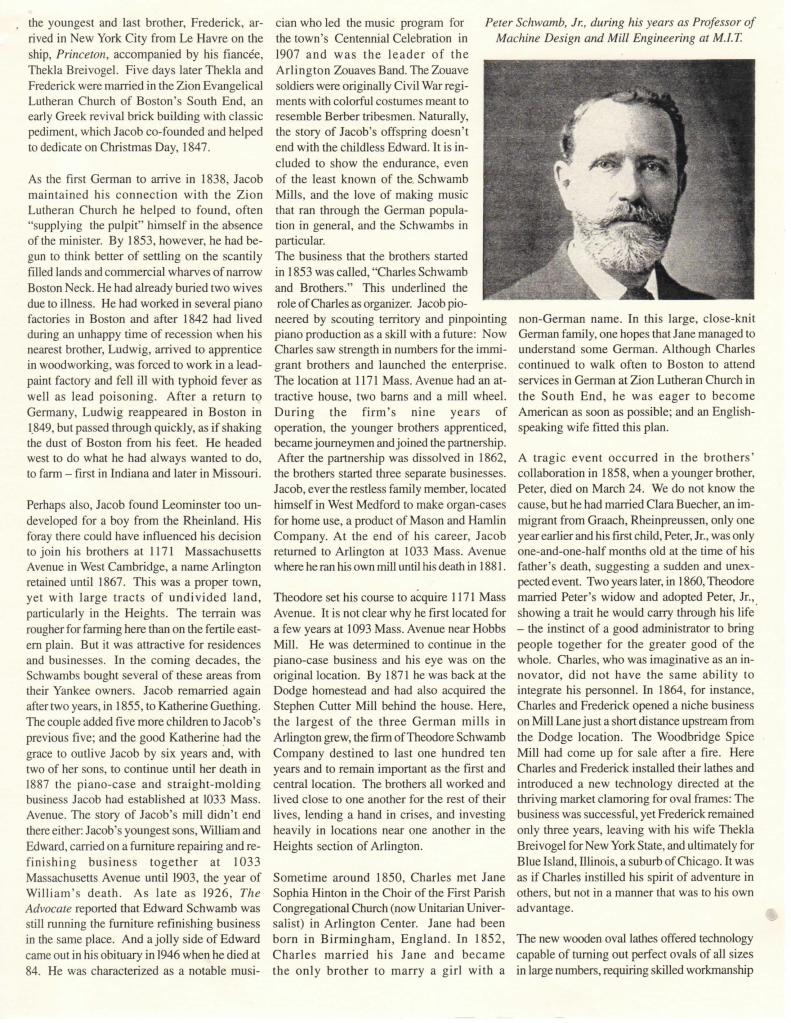
Theodore’s great talent for attracting and keeping talent was especially strong within his larger family. After Theodore’s only son by Clara died at the age of two in 1866, Theodore set his hopes on his adopted son, Peter, Jr. Peter became, one might say, a perfect adopted son. He completed M.I.T. and rose there to become a professor of Mechanical Design and Mill Engineering, and head of the M.I.T. Mechanical Laboratories. Moreover, in Peter, Theodore had a son who could enhance his own profile in civic affairs, particularly in the 1890s, when Peter served on the committees to build two of Arlington’s three most beautiful schools, the old High School on Academy Street, now the Senior Center; and the Cutter and Locke schools, placed at strategic intervals along Massachusetts Avenue as far as Park Avenue in the Heights. For the planning of the Locke, Peter was Committee Chairman. Presumably due to the really outstanding aesthetic of their architecture, and their solid construction, these schools were saved from the wrecker’s ball and even though they were threatened at times in the years when school divestment was the fashion, the premise being that the school-age population would continue to decline. In 1899 also, Peter Schwamb, a long-time member of the Arlington Water Commission, was, in the words of William Cutter, “instrumental in having the town admitted into the Metropolitan water system.” He remained active at Theodore Schwamb Company and joined in its incorporation as Treasurer in 1897. After Theodore’s death in 1909, Peter took early retirement from M.I.T. and worked even more closely with the company until his own retirement in 1924.
While Theodore Schwamb built his company slowly, Charles leapt ahead quickly. From 1864 to 1879, Theodore’s expansion was slower than Charles’s. In 1878, for instance, when the bulk of the Mill owners were awarded damages for the drastic curtailment of the waters of the Sucker Brook due to the excavation of the Heights Reservoir, Theodore received $6,024.16. Charles Schwamb, on the other hand, still riding the crest of the vastly popular oval frame business, received $11, 587.58. In 1875, The Arlington Advocate noted that Charles Schwamb had acquired “a .snug fortune” in his business. In October of that year, he organized a surprise party among his thirty-five mill workers to welcome his twentyone-year-old son, Carl William, into his business as a partner. “The men in the establishment last Friday evening, despite the unfavorable state of the weather, marched in a body to the residence of Mr. Schwamb to congratulate the new firm.” The “residence” was an impressive new mansard-roof house, which Charles had recently constructed at what is now 22 Fessenden Street. What Carl William, an artistic young man, thought ofjoining a dusty business (it was apparent later that his lungs were delicate), is a good question. But if he had to choose sawdust, rather than music, nevertheless, he remained a dutiful son and partner in the firm. He was the only son available at that time. When his only brother, Herbert Page, reached maturity 11 years later, he chose to go west to Denver. Within these limitations, Carl and his parents seemed to understand one another. He served as alternate organist, not only at the First Baptist Church where the family worshipped, but at various churches in the Heights and in Lexington. He was pianist for many years for the Sunday school of the First Baptist; and he designed music curriculum for the Arlington schools. Carl William died at the relatively early age, of 57 in 1912; yet for many decades thereafter a harpsichord stood on the third floor of the Mill as a reminder. In gratitude for Carl William’s contributions to the First Baptist Church in Arlington Center, the parish gave him an intricately carved square piano, an instrument which has been lovingly restored in the family of his granddaughter, Dorothy Sweet Raman, of Macomb, Illinois.
In 1879, the market for oval frames collapsed as square frames became the fashion. To the array of modem equipment Charles already had —rotary planers, band saws, circular saws and jigsaws, boring machines used for dowelling, and common and eccentric turning lathes — he now installed a molding machine, capable of being set to finish any possible design for straight stock, and to fashion any contour a frame maker might want. An enlarged second floor was added to accommodate the long lengths of stock. Charles was also helped with orders subcontracted from his brother, Jacob, who had for several years been operating in his own Mill at 1033 Mass. Avenue next to the building that is today Stop and Shop Pharmacy. (Not until 1919 did this parcel go out of Schwamb hands, when it was sold to a manufacturer of electric repair parts, and carbon and metal brushes used in automobiles. The Advocate reported that “The building is of the olden time construction and the timbers are put together with wooden pins, heavy timbers being used and many of them, quite a contrast to the buildings of today”. In recent years, several nostalgic mill enthusiasts have looked for this treasure, only to leave again cursing the brick-cube apartment building which has replaced it.)
In the early 1890s, America experienced a severe economic panic, followed by a prolonged recession. It is therefore surprising to read that the Theodore Schwamb Company saw constant growth, both in the 1890s and in the first years of the new century. In 1898, the year after its incorporation, the Company was the largest single business in Arlington. Directors were Peter Schwamb, Treasurer, Philip Eberhardt, Clerk and Assistant Superintendent, and Jacob Bitzer, Head of the shop. New property was purchased behind the Mill in 1905. In the same year, a narrow-gauge spur railroad track was added, linking the firm to the railroad and enabling the company to receive and deliver almost in the manner of a private railroad. Among the new structures, the largest was the four-story brick building, which today still bears uppermost on its facade the words, THEODORE SCHWAMB CO., ready for the passers-by of the twenty-first century.
As the middle class began to upscale its musical tastes in the new century, the vogue for upright pianos gave way to the aspiration for a grand piano. Theodore Schwamb Co. followed the trend, which required not only skill but speed and coordination in gluing veneers to its fine hardwoods. As the new century dawned, however, the first generation seemed suddenly to have grown quite venerable. At Charles Schwamb and Son Co., the heir apparent, Carl William, was on a protracted stay in Denver to improve his health. At the Mill, shop superintendent, John Frederick Bitzer, oldest brother of Jacob Bitzer, carried on as he had for 36 years. One cannot see how much sales work could have been going on.
For Charles, by nature an energetic entrepreneur, looking back from the vantage of 1900 must have been daunting. Of the nine children born to him and to Jane Hinton, seven were dead. Two sons and a daughter died shortly after birth; but the unthinkable happened from 1884 to 1891. His four grown daughters, lovely young women if one may judge from their photos, all died, one after another in successive years. Evidence strongly suggests a family tendency to tuberculosis, though the only written evidence concerns their youngest daughter, Jennie Louise Schwamb Wyman, who had recently given birth to a daughter. Two weakening bouts of pneumonia are mentioned, one before and one after the baby’s birth (the baby also died within a few months). When Charles Schwamb died in 1903 at the age of seventy-six, his faithful superintendent, John Frederick Bitzer, resigned immediately and joined his youngest brother, Jacob Bitzer, at Theodore Schwamb, where he remained for the rest of his professional life.
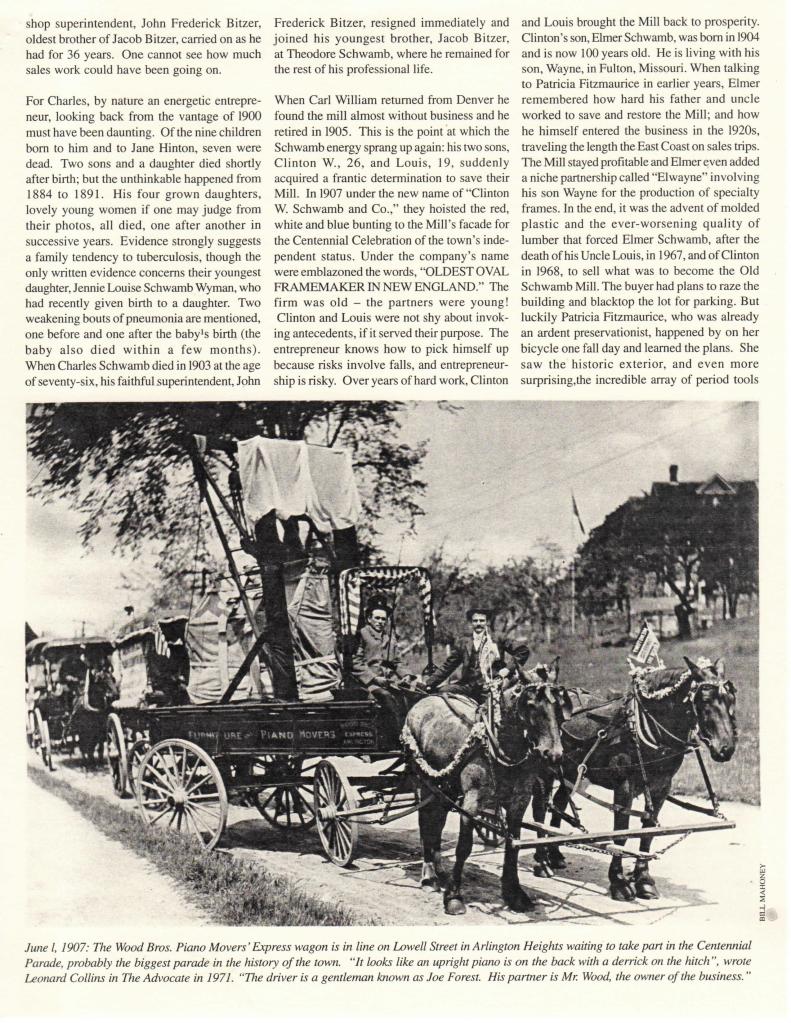
When Carl William returned from Denver he found the mill almost without business and he retired in 1905. This is the point at which the Schwamb energy sprang up again: his two sons, Clinton W., 26, and Louis, 19, suddenly acquired a frantic determination to save their Mill. In 1907, under the new name of “Clinton W. Schwamb and Co.,” they hoisted the red, white and blue bunting to the Mill’s facade for the Centennial Celebration of the town’s independent status. Under the company’s name were emblazoned the words, “OLDEST OVAL FRAMEMAKER IN NEW ENGLAND.” The film was old—the partners were young! Clinton and Louis were not shy about invoking antecedents, if it served their purpose. The entrepreneur knows how to pick himself up because risks involve falls, and entrepreneurship is risky. Over years of hard work, Clinton and Louis brought the Mill back to prosperity.
Clinton’s son, Elmer Schwamb, was born in 1904. When talking to Patricia Fitzmaurice in earlier years, Elmer remembered how hard his father and uncle worked to save and restore the Mill; and how he himself entered the business in the 1920s, traveling the length the East Coast on sales trips. The Mill stayed profitable and Elmer even added a niche partnership called “Elwayne,” involving his son Wayne for the production of specialty frames. In the end, it was the advent of molded plastic and the ever-worsening quality of lumber that forced Elmer Schwamb, after the death of his Uncle Louis, in 1967, and that of Clinton in 1968, to sell what was to become the Old Schwamb Mill.
The buyer had plans to raze the building and blacktop the lot for parking. But luckily Patricia Fitzmaurice, who was already an ardent preservationist, happened by on her bicycle one fall day and learned the plans. She saw the historic exterior, and even more surprising, the incredible array of period tools and machines within. With the help of a small group of concerned Arlingtonians, she started the process that would result in the creation of a working museum, the Old Schwamb Mill, now in operation for 35 years.
Theodore Schwamb died in 1909. The piano-case business began to lag with the increasing interest in recordings, and especially with the advent of the radio in the early 1920s. Peter Schwamb retired in favor of Philip Eberhardt in 1924 and died unexpectedly in 1928 in the midst of his family at his house at 33 Academy Street. When Philip Eberhardt sold the business to the Nickerson family in 1931, the company name of Theodore Schwamb was retained. A decision was made to switch products to high-end architectural woodworking. This was a felicitous decision, given the extensive interior areas available and the skills, particularly of Italian workers, in the area. During the next forty-plus years, the Theodore Schwamb Co. became known nationwide for large projects of interior wood paneling and woodcarving.
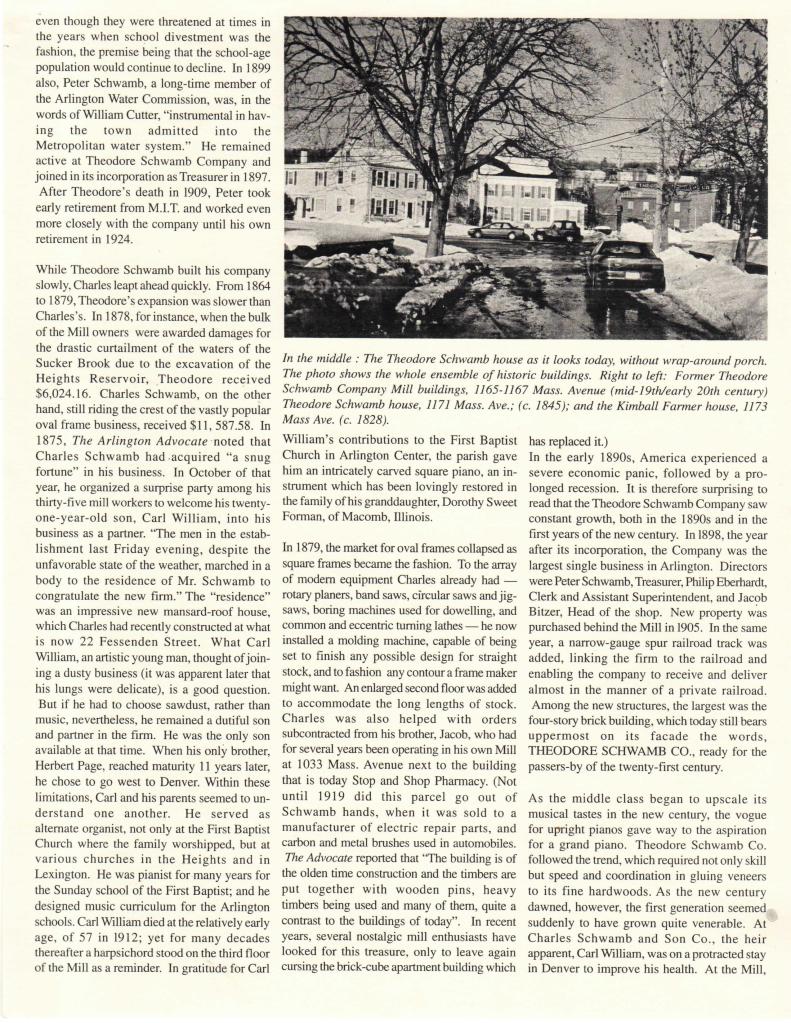
Their work included elaborate projects for Yale University in New Haven; for the Tryon Palace at New Bern, North Carolina; for the original John Hancock Building in Boston and at the Harvey Firestone Library at Princeton, N.J. The firm of Cascieri di Biccari (the late Archangelo Cascieri, Dean of the Boston Architectural Center and Adio di Biccari, Arlington sculptor) opened a studio at Theodore Schwamb. Over four decades, this firm produced a wealth of carving and sculpture, including the exquisite Cascieri carvings for Marsh Chapel at Boston University; and the di Biccari sculpture ensemble opposite West Street on the Boston Common One photo, taken in Arlington at the Schwamb Studio in the 1950s, shows a giant sculpture of St. Clement. The ponderous saint lies prone on a truck, having made it through of the wide doors of the Schwambs’ most attractive structure, a small, classic brick building with brick detail, a building still extant today at 1167 behind the old homestead. After arriving safely at his Brighton destination, St. Clement was hoisted to very top of the facade of St. John Seminary.
The fact that such buildings still exist is to the credit of the Mirak family, a long-time Arlington family whose firm has specialized since 1936 in dealerships and service of cars and trucks. Recently, the firm developed a residential complex in Arlington Center called “The Legacy.” Robert Mirak recently commented that “when my father, John Mirak, purchased the property in the 1970s, some of his colleagues suggested tearing down the buildings to make way for another dealership or a major shopping center. My father decided to keep the buildings and used the property to store excess auto inventory. In addition, he liked the looks of the buildings and especially the handsome red brick and the colonial windows. From that time to the present, my father and in succession, the family has upgraded the buildings. Inside, over the decades, we have upgraded floors and brickwork. Specifically, the original wood flooring, which was blackened by use, was cleaned, sanded and urethaned to a handsome finish. Also, a number of walls were sandblasted to remove the paint on the brick; the results were sparkling.”
At this Theodore Schwamb complex, it is gratifying to see how many small businesses have found a home: the Image Inn has run a photographic studio there since 1982, specializing in the rare skills and patience required by traditional techniques; the architectural firm of Rovinelli is upstairs at 1167; and there are many individual’ artists in residence at the large complex at 1165, as well as the new WorkBar, established in 2016.
The Charles Schwamb Mill at 17 Mill Lane did not grow as large as the Theodore Schwamb Company, and it was never as visible, either. But however much the market fluctuated, Charles Schwamb and his descendants never gave up making fine oval frames. Amidst the final commercial years of competition from inferior wood and plastics, the Mill continued this work, as it does today, thanks to the late Patricia Fitzmaurice and her supporters.
In the end, the Old Schwamb Mill can lay claim to having endured, both as living history and as a working Mill. All three brothers, Theodore and Charles and Jacob, could be proud that their generation of immigrants achieved so much that is still treasured in Arlington today.

